GeekCoding101
Parameters are the numbers a model learns during training, mainly weights and biases, and together they decide how the model turns an input into an output. Bigger models are often smarter because more parameters let them capture more complex patterns. That only holds when they are trained on enough data with enough compute, and the extra size always costs memory, money and energy.
1. What Are Parameters?
In deep learning, parameters are the trainable components of a model. During training they are adjusted, step by step, to reduce the model’s errors. Parameter count is simply the total number of these weights and biases.
You can think of parameters as the “brain capacity” of an AI model. More parameters give the model more room to store patterns it has learned from data. The analogy has a limit, though: capacity is not the same as knowledge. An untrained model with billions of parameters knows nothing.
A tiny example: a simple linear regression model with one input has just two parameters:
- a weight w
- a bias b
It predicts y = w · x + b, and training finds the values of w and b that fit the data best.
Counting parameters in a neural network layer: a fully connected layer with n inputs and m outputs has:
- n × m weights (one for every input–output connection)
- m biases (one per output)
For example, a layer taking 784 inputs (a 28×28 image) to 128 outputs has 784 × 128 + 128 = 100,480 parameters. Stack many layers like this, and add attention layers in a Transformer, and the count climbs into the billions.
2. Parameters vs. Hyperparameters
These two terms are easy to mix up:
| Parameters | Hyperparameters | |
|---|---|---|
| What they are | Weights and biases inside the model | Settings that control training or model shape |
| Who sets them | Learned automatically during training | Chosen by the engineer before training |
| Examples | Layer weights, biases, embedding values | Learning rate, batch size, number of layers |
| Saved in the model file? | Yes, they are the model | Usually recorded in a config, not learned |
When people say a model has “7 billion parameters,” they mean learned weights and biases, not settings.
3. How Many Parameters Do Well-Known Models Have?
| Model | Type | Parameters |
|---|---|---|
| Linear regression (one input) | Classic ML | 2 |
| ResNet-50 | Computer vision (CNN) | ~25 million |
| BERT-base | Language (encoder) | ~110 million |
| ViT-Large | Computer vision (Transformer) | ~300 million |
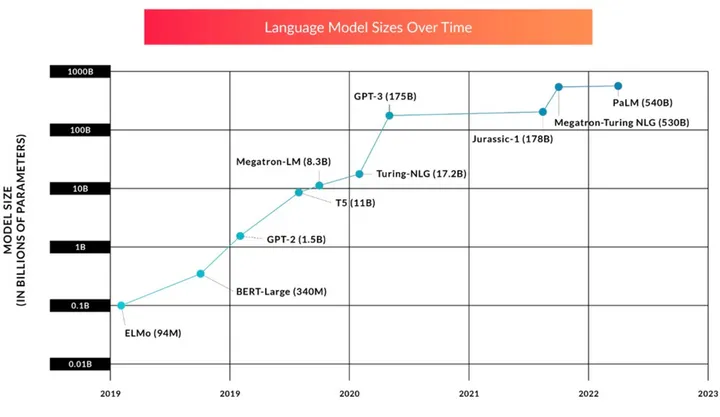
| GPT-2 | Language model | 1.5 billion |
| GPT-3 | Language model | 175 billion |
| GPT-4 | Language model | Not disclosed by OpenAI |
A note on GPT-4: OpenAI has not published its parameter count. Figures you may see online, such as “1.7 trillion,” are unofficial estimates, not confirmed numbers.
As language models grew from GPT-2 to GPT-3, they showed clear improvements in:
- Text fluency: more coherent, context-appropriate responses
- Reasoning: better at logical puzzles and step-by-step explanations
- Creativity: writing essays, poetry and code snippets
In computer vision, the same pattern appears. Vision Transformers (ViT) with hundreds of millions of parameters can outperform traditional convolutional networks such as ResNet on complex image tasks, especially when they are pretrained on very large datasets.
4. Why Are Bigger Models Often Smarter?
In deep learning there is often a positive relationship between parameter count and performance. Research on scaling laws shows that as parameters, training data and compute increase together, model performance improves in a fairly predictable way.
Three reasons stand out:
- Higher expressive power. Larger models can capture more complex patterns. A language model doesn’t just learn grammar; it picks up deeper meaning, context and nuance.
- Stronger generalization. With enough training data, larger models handle unseen situations better, such as novel questions or unfamiliar topics.
- Versatility. Bigger models can handle many tasks with little or no extra training. OpenAI’s GPT models, for example, can write, translate, generate code and reason through problems with the same set of weights.
5. Size Isn’t Everything: Data and Training Matter
Parameter count is only one of the three ingredients. The other two are data and compute.
- Too many parameters for too little data → overfitting. If the model is much larger than the data or the task requires, it can memorize training examples instead of learning general patterns.
- Undertrained large models waste capacity. DeepMind’s Chinchilla research (2022) found that many large models of the time had been trained on too little data for their size. A smaller model trained on more data could match or beat a larger one with the same compute budget.
- Architecture and data quality count too. Two models with the same parameter count can perform very differently depending on how they are built and what they were trained on.
So “bigger is smarter” is a useful rule of thumb, not a law.
6. What Parameter Count Means in Practice: Memory and Cost
Every parameter has to be stored as a number, so parameter count translates directly into memory. A quick estimate for the weights alone:
Memory ≈ parameters × bytes per parameter
| Precision | Bytes per parameter | 7-billion-parameter model (weights only) |
|---|---|---|
| FP32 (32-bit float) | 4 | ~28 GB |
| FP16 / BF16 (16-bit) | 2 | ~14 GB |
| INT8 (8-bit) | 1 | ~7 GB |
| 4-bit | 0.5 | ~3.5 GB |
This is a lower bound. Running the model needs extra memory for activations and, in language models, the context cache. Training needs far more, because gradients and optimizer states are stored alongside the weights.
This is why parameter count matters so much in practice. It decides whether a model fits on a laptop, a single server or only a large cluster. It also drives what each response costs to serve.
7. Are Bigger Models Always Better?
Advantages of large models
- Capture complex patterns: they model relationships in data that smaller models miss.
- Task versatility: one large model can handle diverse tasks without much fine-tuning.
- Performance breakthroughs: larger models often set state-of-the-art results across many benchmarks.
Drawbacks of large models
- High computational cost: training and inference both demand large resources. Training GPT-3 reportedly cost millions of dollars in compute.
- Energy consumption: training at this scale uses a lot of energy and has a real environmental impact.
- Efficiency issues: for many specific tasks, a smaller, task-specific model gets similar results with far fewer resources.
- Slower responses: more parameters mean more computation per token, which increases latency.
Choosing a model size means balancing performance gains against cost, speed and the hardware you actually have.
8. Trends: Making Models Smaller and More Efficient
Despite the success of large models, a lot of current work focuses on getting more out of fewer parameters:
- Knowledge distillation: a large “teacher” model trains a smaller “student” model to imitate its outputs. The student keeps much of the teacher’s ability at a fraction of the size. DistilBERT, a distilled version of BERT, is a well-known example.
- Pruning: removing weights that contribute little, so the model gets smaller and faster.
- Quantization: storing weights at lower precision (8-bit or 4-bit instead of 16- or 32-bit). This cuts memory, as the table above shows, usually with a modest loss in quality.
- Mixture of Experts (MoE): the model has many parameters in total, but only a subset is active for each token. This is why some models list both “total” and “active” parameter counts.
- Task-specific fine-tuning: instead of using a massive model for every problem, fine-tuning a smaller pretrained model for one task is often more cost-effective.
The likely direction is a combination of both approaches. Large-scale pretraining builds broad general ability, and smaller fine-tuned or distilled models put that ability to work efficiently.
9. One-Line Summary
Parameter count is the “brain capacity” of an AI model. Larger models often excel at complex tasks, but data, training and efficiency decide whether that capacity turns into real intelligence you can afford to run.
FAQ
What are parameters in an LLM? They are the learned weights and biases inside the model’s layers, including its attention and embedding layers. When someone says “a 7B model,” they mean about 7 billion of these learned numbers.
Does more parameters always mean a better model? No. More parameters raise a model’s potential, but it also needs enough high-quality training data and compute. A well-trained smaller model can beat a poorly trained larger one.
How much memory does a model need for its parameters? Multiply the parameter count by the bytes per parameter: 4 for FP32, 2 for FP16, 1 for INT8, 0.5 for 4-bit. A 7B model needs about 14 GB in FP16 for weights alone, and running it takes more.
What’s the difference between parameters and hyperparameters? Parameters are learned by the model during training. Hyperparameters, such as learning rate, batch size and number of layers, are chosen by the engineer before training starts.
How many parameters does GPT-4 have? OpenAI has not disclosed it. Any specific number you see is an unofficial estimate.
Your Thoughts
Do you think the race for larger models is sustainable, or should the focus shift toward efficiency and accessibility? Share your perspective in the comments below! Thanks for reading my blog post! Feel free to check out my other posts or contact me via the social links in the footer.