GeekCoding101
The Transformer is called an AI revolution because it replaced step-by-step models (RNNs and LSTMs) with self-attention. Self-attention lets a model look at a whole sequence at once and weigh how every word relates to every other word. That one change made training far more parallel and much better at long-range context. It also made models scalable enough to become the foundation of today’s large language models, including the GPT series and BERT.
This is the first post in Daily AI Insight, a GeekCoding101 series that breaks one AI concept down into a short, readable explainer at a time.
Key takeaways
- What it is: a deep learning architecture introduced in the 2017 paper Attention Is All You Need, by researchers at Google.
- What changed: self-attention processes all tokens in parallel instead of one at a time.
- Why it matters: faster training, better context, and an architecture that scales. Modern LLMs are built on it.
- What it costs: heavy compute, huge training datasets, attention cost that grows quickly with input length, and limited interpretability.
What Is the Transformer?
The Transformer is a neural network architecture first designed for natural language processing (NLP) tasks such as machine translation. It has since spread well beyond text. It now underpins state-of-the-art models in computer vision, speech processing, and multimodal AI.
The problem it solved: RNNs and LSTMs
Before the Transformer, most NLP models were RNNs (Recurrent Neural Networks) and LSTMs (Long Short-Term Memory networks). They had two big weaknesses:
- Sequential processing. They read text one token at a time. Each step depended on the previous one, so training was hard to parallelize and slow on large datasets.
- Weak long-range memory. In long sentences or documents, information from early in the input tended to fade by the time the model reached the end.
The Transformer solved both with a self-attention mechanism. Think of it as giving the model a panoramic lens. Instead of reading one word at a time, it sees the entire context at once and focuses on the parts that matter most.
| RNN / LSTM | Transformer | |
|---|---|---|
| How input is processed | One token at a time, in order | All tokens at once, in parallel |
| Long-range context | Fades over long inputs | Any token can attend directly to any other |
| Training speed on large data | Limited by sequential steps | Much easier to parallelize |
| Scaling to very large models | Difficult | The basis of modern LLMs |
How Does the Transformer Work?
Self-attention: the core idea
Self-attention lets the model calculate how important each word is to every other word in the sequence. Take this sentence:
“The trophy didn’t fit in the suitcase because it was too big.”
To understand “it,” the model needs to link it to “trophy,” not “suitcase.” Self-attention gives every word a direct line to every other word, so the model can learn that connection however far apart the words are.
In practice, each token is turned into three vectors:
- a query: what this token is looking for
- a key: what this token offers
- a value: the information it carries
The model compares each query with every key to produce attention weights. It then uses those weights to blend the values into a new, context-aware representation of each token.
Two more pieces make this work:
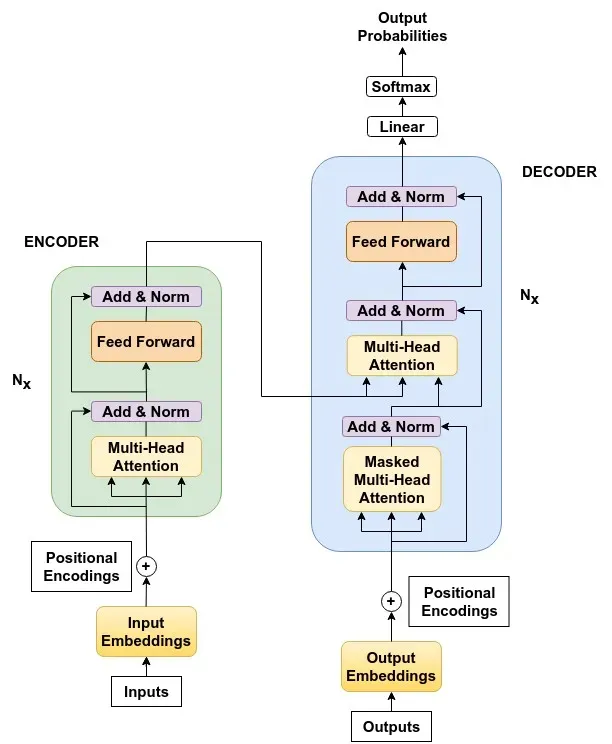
- Multi-head attention. The model runs several attention calculations side by side, so it can track different kinds of relationships at once. One head might follow grammar while another follows meaning.
- Positional encoding. Because all tokens are processed together, the model adds information about word order so “dog bites man” and “man bites dog” stay different.
The encoder
The encoder reads the input sequence and turns it into rich, context-aware vector representations. In a translation task, it might analyze “I love programming” and produce an embedding for each word that captures its meaning and its relationship to the other words.
The decoder
The decoder takes those representations and generates the output one token at a time. For translation, it might turn the encoded English sentence into “J’aime programmer” in French.
Three families of Transformer models
The original 2017 model used both an encoder and a decoder. Many of today’s best-known models use only one half:
| Type | What it’s good at | Example |
|---|---|---|
| Encoder-only | Understanding text: classification, search, question answering | BERT |
| Decoder-only | Generating text, one token after another | GPT series |
| Encoder-decoder | Turning one sequence into another, e.g. translation | The original Transformer |
Why Is the Transformer Considered Revolutionary?
The Transformer changed how models process, understand, and generate information. Three things stand out.
1. Parallel processing
RNNs work step by step. Transformers analyze all parts of the input at once. This parallelism speeds up training dramatically, which made it practical to train on massive datasets.
2. Better understanding of context
Self-attention captures relationships between all tokens in a sequence, not just neighboring ones. In “Although it was raining, she decided to go for a run,” the model can connect “although” with “decided” even though other words sit between them. That link is what gives the sentence its meaning: she went anyway.
3. Scalability
The architecture is modular: stacks of identical attention and feed-forward layers. You can make it bigger by adding layers, widening them, and training on more data. That is why large language models such as OpenAI’s GPT series and Google’s BERT are built on this architecture.
Key Applications and Models
Natural language processing
- BERT (Bidirectional Encoder Representations from Transformers): a Google model for understanding text in context. It is widely used in search, question answering, and sentiment analysis.
- GPT series (Generative Pre-trained Transformers): OpenAI’s models for text generation, from creative writing to code completion. They are also the foundation of ChatGPT.
Computer vision
- Vision Transformer (ViT): splits an image into patches, treats them like tokens, and applies self-attention to understand how different parts of the image relate.
Multimodal AI
- CLIP and DALL-E: use Transformers to work with both text and images. They can match images to descriptions and generate images from text prompts.
Challenges and Limitations
The Transformer is powerful, but it has real costs:
- High computational cost. Training large Transformers takes enormous compute and specialized accelerators such as GPUs or TPUs. Running them at scale is expensive too.
- Attention grows quickly with input length. Every token attends to every other token, so the cost of standard self-attention grows with the square of the sequence length. This is a key reason long context windows are hard and expensive.
- Data-hungry. Large models are pre-trained on vast amounts of text. Most of it is unlabeled, and the model learns by predicting missing or next tokens. Collecting and processing data at that scale is out of reach for many smaller teams.
- Limited interpretability. Attention weights give some hints, but the inner workings remain largely a “black box.” That is a problem in fields like healthcare and law, where decisions need to be explained.
- Confident mistakes. Generative Transformers can produce fluent answers that are simply wrong. We cover why in The Hallucination Problem in Generative AI.
The Transformer’s Impact
The Transformer reshaped both AI research and everyday tools. It made possible big leaps in natural language understanding, image recognition, and generative AI. It is the foundation behind ChatGPT, modern machine translation, and many content-creation tools.
In one line: the Transformer revolutionized AI by replacing step-by-step processing with parallel self-attention, and that is what made today’s large language models possible.
FAQ
What does “Attention Is All You Need” mean?
It is the title of the 2017 paper that introduced the Transformer. The point of the title was that a model could drop recurrence entirely and rely on attention mechanisms alone to handle sequences. That turned out to be faster to train and better at long-range context.
Is ChatGPT a Transformer?
Yes. ChatGPT is built on OpenAI’s GPT models, and GPT stands for Generative Pre-trained Transformer. These are decoder-only Transformers that generate text one token at a time.
What is the difference between an encoder and a decoder?
An encoder reads the input and builds a context-aware representation of it. A decoder generates output step by step. BERT uses only the encoder, GPT uses only the decoder, and the original translation model used both.
What is the difference between pre-training and fine-tuning?
Pre-training is the first, expensive stage. The model learns general language patterns from a huge amount of text, typically by predicting missing or next tokens. Fine-tuning comes after. The pre-trained model is trained further on a smaller, task-specific dataset so it gets better at a particular job or behavior.
Did Transformers completely replace RNNs?
For most large-scale language tasks, yes: Transformers became the default architecture. RNNs and LSTMs are still used in some smaller or streaming settings, and researchers keep exploring alternatives that avoid attention’s high cost on long inputs.
Next in Daily AI Insight: What Is an Embedding? The Bridge From Text to the World of Numbers.