GeekCoding101
A foundation model is a large, general-purpose AI model pretrained on broad data so it can be adapted to many different tasks. A task model is a model built or adapted to do one specific job well, such as sentiment analysis, translation or contract review. It is often made by fine-tuning a foundation model.
Most real AI systems use both. The foundation model supplies general ability, and the task model adds precision for one domain. Knowing which one you need, and how to get from one to the other, helps you balance performance and cost.
info: This topic sits right next to Pretraining vs. Fine-Tuning, but the two are not the same thing. Pretraining and fine-tuning are training steps. Foundation models and task models are the models you end up with. A foundation model is the product of pretraining. A task model is often the product of fine-tuning a foundation model. This post focuses on the models themselves.
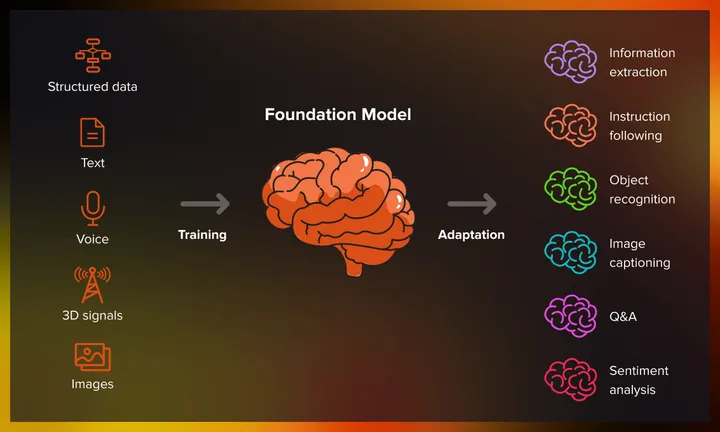
Foundation models vs task models at a glance
| Aspect | Foundation models | Task models |
|---|---|---|
| Purpose | General-purpose, supports many applications | Focused on one task or domain |
| Training data | Large, broad datasets (e.g., web text, Wikipedia, news, books) | Domain-specific datasets (e.g., legal texts, clinical notes, product reviews) |
| How they’re made | Pretraining, which needs very large compute budgets | Fine-tuning, distillation or custom training, which needs far less compute |
| Size | Typically billions of parameters | Often much smaller and optimized for production |
| Flexibility | Adapts to many tasks via prompting or fine-tuning | Limited to its task, but usually more accurate and predictable there |
| Typical cost to run | Higher per request | Lower per request |
In short: foundation models are the base layer of modern AI, and task models are what you build on top of that layer for a specific application.
What is a foundation model?
Foundation models are general-purpose models trained on very large amounts of data so they can handle a wide range of contexts. Their goal is to serve as a broad base of knowledge and skills that many applications can reuse with little additional training.
Well-known examples include GPT-4, BERT and PaLM. None of them was built for one task. They were built to be flexible, with a deep grasp of grammar, structure and meaning. They do not all work the same way. GPT-4 and PaLM generate text. BERT is built to understand text and is usually adapted for tasks like classification or question answering.
Foundation models are not limited to text. The same idea applies to models trained on images, code, audio, or several of these at once.
Key features
- Massive scale: they often have billions of parameters. (New to the term? See my earlier post What Are Parameters?)
- Multi-purpose: they can be adapted to many tasks through prompt engineering or fine-tuning. (See What Is Prompt Engineering and What Is Fine-Tuning.)
- Pretraining-driven: they are trained on broad datasets to learn general patterns of language or other data. (See Pretraining vs. Fine-Tuning.)
Think of a foundation model as a jack-of-all-trades: broadly knowledgeable, but not specialized in any one field.
What is a task model?
Task models are AI models designed or fine-tuned to excel at one specific task, such as sentiment analysis, machine translation or medical document classification. Foundation models aim for breadth. Task models are purpose-built for a particular goal.
Key features
- Task-specific: optimized for a narrow set of objectives.
- Domain-specific data: trained on data tailored to the task, such as legal contracts, medical records or customer reviews.
- Lightweight and deployable: usually smaller, cheaper and easier to run in production.
Examples
- A sentiment analysis model labels a tweet or review as positive, negative or neutral.
- A medical triage model analyzes patient data and flags possible conditions for a clinician to review.
Task models are like specialists. They are less versatile than foundation models but highly effective in their own area.
How a foundation model becomes a task model
You rarely build a task model from nothing. These are the usual routes, from least to most effort:
| Approach | What you do | When it fits |
|---|---|---|
| Prompting (zero-shot / few-shot) | Describe the task, optionally with a few examples, and use the foundation model as-is | Quick prototypes and tasks the base model already handles well |
| Fine-tuning | Continue training the foundation model on task-specific data | You have labeled data and need consistent, domain-accurate output |
| Parameter-efficient fine-tuning (e.g., LoRA) | Train a small set of extra weights and leave the base model frozen | You want fine-tuning results with less compute and storage |
| Knowledge distillation | Train a smaller “student” model to imitate a larger “teacher” model on your task | You need a small, fast model for production |
| Training a dedicated model | Train a small model directly on your task data | The task is narrow and well-defined, and you have enough data |
Once you have a task model, techniques such as quantization can shrink it further for deployment. See Quantization: How to Unlock Incredible Efficiency on AI Models.
Why do we need both?
Foundation models: broad utility
Foundation models give you a strong starting point for many applications, which saves time and resources. For example:
- Use a generative model like GPT-4 for general-purpose language understanding and writing.
- Use BERT as a base for language tasks like question answering or classification.
Task models: precision and efficiency
Task models matter when accuracy, domain knowledge or running cost are critical. For example:
- Fine-tune a foundation model to draft contracts that follow your legal templates.
- Train a dedicated model for medical imaging analysis.
Combining the two gives you both adaptability and precision.
Real-life examples: foundation models + task models together
Example 1: Healthcare AI
- Foundation model: understands general and medical terminology.
- Task model: fine-tuned on clinical records to draft diagnostic reports, with clinicians reviewing the output.
Example 2: E-commerce recommendations
- Foundation model: analyzes general customer sentiment across reviews.
- Task model: trained on purchase behavior to recommend specific products.
Example 3: Legal document automation
- Foundation model: provides general language comprehension.
- Task model: generates contracts that follow legal requirements, using domain-specific training.
Which one should you use?
- Start with a foundation model plus good prompts if the task is general, you lack labeled data, or you are still exploring.
- Fine-tune into a task model if prompting is not consistent enough, the domain has its own vocabulary, or output must follow strict rules.
- Distill or train a small task model if you need low latency, low cost per request, or to run on limited hardware.
Where it’s heading
The line between the two is likely to keep blurring:
- Foundation models keep getting stronger. As pretraining improves, more tasks can be handled with little or no fine-tuning, through zero-shot or few-shot prompting.
- Task models stay relevant. Work that needs deep domain expertise, strict accuracy or cheap high-volume inference will still benefit from task-specific training.
The two work together, so AI can handle both general and niche problems.
One-line summary
Foundation models provide the broad, flexible base for AI, and task models deliver focused, specialized solutions built on top of it.
FAQ
Is GPT-4 a foundation model? Yes. GPT-4 is a general-purpose model pretrained on broad data and used for many different tasks, which is what makes it a foundation model.
Is a fine-tuned model a task model? Usually, yes. Fine-tuning a foundation model on data for one job, such as classifying support tickets, produces a task model.
Are foundation models the same as pretraining? No. Pretraining is the training process. A foundation model is the result of that process.
Do I always need to fine-tune a foundation model for my task? No. Many tasks work well with prompting alone. Fine-tune when prompting does not give consistent or accurate enough results for your domain.
Are task models always smaller than foundation models? Often, but not always. A fine-tuned task model can be as large as its base model. Distillation and quantization are common ways to make it smaller.
Final thoughts
Understanding the difference between foundation models and task models is key to using AI well. Whether you are building a general-purpose tool or solving a domain-specific problem, the real decision is when to rely on a foundation model and when to invest in a task model.
You can find more posts in the AI Insights series here [keep: existing link to AI Insights posts]. Thanks for reading!