GeekCoding101
Zero-Shot vs Few-Shot Learning: How They Work and When to Use Each
Zero-shot learning means an AI model performs a task without seeing any labeled examples of that task. It relies only on what it learned during pretraining plus a description of the task. Few-shot learning means the model gets a small number of labeled examples first, often between 1 and 10, and uses them to work out what you want.
Both ideas grew out of transfer learning: a model trained on a large, general dataset reuses that knowledge on new tasks with little or no extra data. Below I cover how each one works, what a zero-shot and a few-shot prompt actually look like, where they’re used, and where they break down.
Quick answer
| Zero-shot | One-shot | Few-shot | |
|---|---|---|---|
| Labeled examples for the task | 0 | 1 | A handful (often 1–10) |
| What the model relies on | Pretrained knowledge + task description | Pretrained knowledge + one example | Pretrained knowledge + a few examples |
| Typical use | Quick tasks with a clear description | Showing a format once | Tasks with a specific style, label set or edge cases |
1. What Is Zero-Shot Learning (ZSL)?
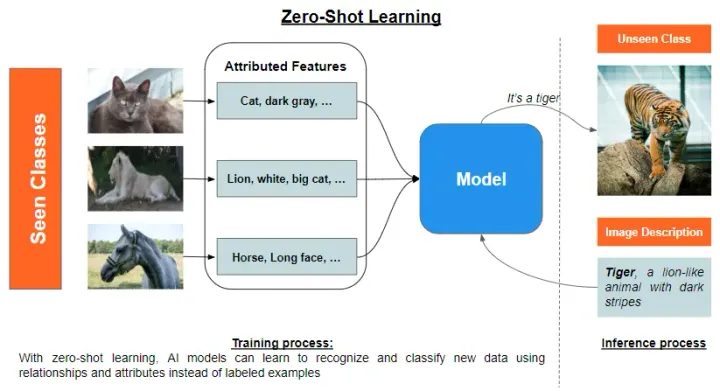
Zero-shot learning is a model’s ability to handle a task it was never trained on with labeled examples. The model doesn’t learn anything new at that moment. It matches the task description against the general knowledge it already has.
Simple example
A vision model has been trained on labeled photos of cats and dogs but has never seen a labeled photo of a tiger. From text, it has learned that a tiger is “a large cat with orange fur and black stripes.” When you show it a tiger and offer “tiger” as a possible label, it can still pick that label. It does this by connecting what it sees with what it knows about the word.
How it works
- Semantic embeddings. Task descriptions (labels or prompts) and data samples are mapped into a shared vector space. The word “tiger” becomes a vector, the image becomes a vector, and the model checks how close they are. CLIP works this way: it compares an image embedding with the text embeddings of candidate labels and picks the closest match.
- Pretrained foundation models. Zero-shot performance depends almost entirely on how much the model absorbed during pretraining. Large language models (such as GPT-4) and vision-language models (such as CLIP) are the usual examples.
- Clear task descriptions. The prompt is the only guidance the model gets, so it has to say exactly what you want and what the possible answers are.
A zero-shot prompt
Classify the sentiment of this review as Positive or Negative.
Review: "The battery died after two days and support never replied."Sentiment:
There are no examples, just the instruction and the input.
2. What Is Few-Shot Learning (FSL)?
Few-shot learning is a model’s ability to complete a task after seeing only a few labeled examples. It’s useful when labeled data is scarce or expensive to collect.
“Few-shot” is used in two different ways, and the old version of this post blurred them:
- Few-shot prompting (in-context learning). You put a few examples directly in the prompt. The model’s weights don’t change; it infers the pattern from the context. This is what most people mean when they talk about LLMs. The idea was popularized by the GPT-3 paper, Language Models are Few-Shot Learners.
- Few-shot training. In classic machine learning, you actually update a model using a very small labeled dataset. This is done through fine-tuning a pretrained model or through methods designed to learn from few examples, such as meta-learning.
Simple example
You want a model to tell apples from oranges. You give it five labeled images of each, and it classifies new images into the two categories. It doesn’t need thousands of training photos, because it already knows a lot about shapes, colors and textures.
How it works
- In-context learning. The examples in the prompt show the model the rule, the label set and the output format.
- Parameter transfer. The model reuses what it learned on related tasks during pretraining, so a few examples are enough to point it in the right direction.
- Light fine-tuning. With few-shot training, a small number of gradient updates on the limited labeled data adjusts the model’s parameters for the new task.
A few-shot prompt
Classify each fruit description as Apple or Orange.
Description: Red, round, smooth skin.Label: Apple
Description: Green, round, smooth skin.Label: Apple
Description: Orange, round, dimpled skin.Label: Orange
Description: Orange, slightly rough, thick peel.Label: Orange
Description: Orange, round, dimpled skin, easy to peel.Label:
The model uses the four examples to work out both the classification rule and the answer format. In this case, the format is a single word.
3. Key Differences Between ZSL and FSL
| Aspect | Zero-Shot Learning (ZSL) | Few-Shot Learning (FSL) |
|---|---|---|
| Data requirement | No task-specific examples | A small number of labeled examples (often 1–10) |
| Approach | General knowledge + natural language task description | Task examples + prior model knowledge |
| Model weights | Unchanged | Unchanged (prompting) or slightly updated (fine-tuning) |
| Good fit | No labeled data available, or the task is easy to describe | Limited labeled data, or the output needs a specific style or format |
| Model dependency | Depends heavily on a strong pretrained model | Needs a pretrained model plus task-specific examples or adaptation |
| Main risk | Vague prompts, missing domain knowledge | Unrepresentative or noisy examples |
4. When to Use Zero-Shot vs Few-Shot
- Start with zero-shot when the task is common and easy to describe, such as summarizing, translating or simple sentiment.
- Move to few-shot when zero-shot results are inconsistent. It also helps when you need a strict output format or your labels are unusual, like an internal category list.
- Consider fine-tuning when even few-shot prompts don’t get you there, or when you’d otherwise repeat the same long set of examples in every request.
5. Real-World Applications
Zero-shot learning applications
- Text classification. Ask an LLM “Is this review positive or negative?” without training it on labeled reviews.
- Image recognition. CLIP can label images from a list of text labels, such as “a photo of a panda,” without being trained on a labeled panda dataset.
- New task inference. General-purpose LLMs can follow instructions for tasks they weren’t specifically trained on, such as rewriting text in a new style or extracting fields from a document, using only their general language understanding.
Few-shot learning applications
- Medical and other specialist domains. A model is adapted with a small set of labeled records where large datasets don’t exist, such as rare conditions. Results here always need expert review.
- Niche classification. Classify reviews for a specific industry (e.g. luxury goods) using only a handful of labeled examples.
- Custom business assistants. A small set of example customer support tickets and replies teaches a model your product’s tone and common answers.
6. Challenges of ZSL and FSL
Challenges of zero-shot learning
- Understanding task descriptions. The prompt is the only guidance, so vague instructions lead to poor or inconsistent output.
- Domain adaptation. Pretrained models may lack specialist knowledge (medical, legal, internal company terms), which limits how well they perform in those areas.
Challenges of few-shot learning
- Sample bias. A handful of examples may not cover the full range of the task, which can lead to overfitting or to copying surface patterns.
- Example quality. A single mislabeled or badly chosen example can mislead the model, so the examples need to be clean and representative.
- Example order and balance. With prompting, the order and mix of examples can affect the answer. For instance, if most examples are “Positive,” the model may lean that way.
7. One-Line Summary
Zero-shot learning lets a model handle a task with no labeled examples; few-shot learning lets it adapt quickly from just a few. Together, they make AI usable even when you have little or no task-specific data.
FAQ
What is the difference between zero-shot and few-shot learning? Zero-shot gives the model only a task description and no examples. Few-shot adds a small number of labeled examples so the model can infer the pattern and format you want.
Is few-shot prompting the same as fine-tuning? No. Few-shot prompting puts examples in the prompt and leaves the model’s weights unchanged. Fine-tuning actually updates the weights using labeled data.
What is one-shot learning? It’s the special case of few-shot learning with exactly one labeled example. It’s often enough to show the model an output format.
How many examples count as “few-shot”? There’s no fixed number. It usually means a handful, commonly somewhere between 1 and 10.
Should I always use few-shot instead of zero-shot? Not necessarily. Few-shot makes prompts longer, and poorly chosen examples can hurt results. Try zero-shot first and add examples only when the output isn’t consistent enough.
Final Thoughts
Zero-shot and few-shot learning show how far pretrained models can go with very little task-specific data. Whether you’re writing a single instruction or putting together a few good examples, the idea is the same: let the model’s general knowledge do most of the work, and give it just enough guidance to aim at your task.
If you want to go further, prompt engineering is the natural next step. Feel free to browse my other AI Insights posts, or reach out via the contact page.