GeekCoding101
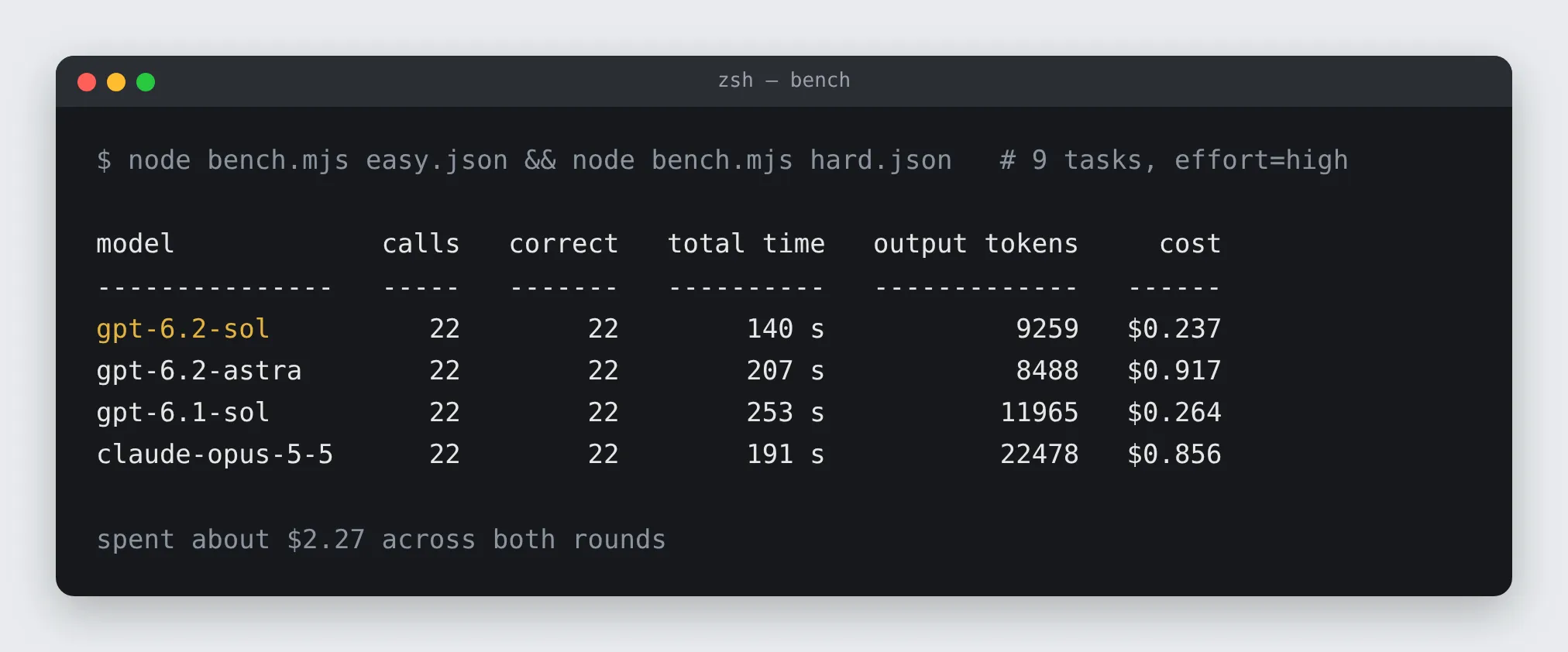
GPT-6.2 Sol and GPT-6.2 Astra are the two models OpenAI shipped on November 17, 2026. Astra is the flagship at 40 per million tokens; Sol is the cheaper tier at 10, the same price as the GPT-6.1 Sol it replaces. The day after the release I gave both of them, plus GPT-6.1 Sol and Claude Opus 5.5, the same nine graded tasks through the API. Every model got every answer right. The difference was entirely time and money: Sol finished fastest and cost about a quarter of Astra.
Why Everyone Is Comparing Them
The launch was announced in a joint post for both models, and Simon Willison’s notes went up the same day. Within a day the searches were all head-to-heads: “6.2 sol vs 6.1 sol”, “6.2 astra vs sol”, “6.2 sol vs opus 5.5”, “gpt 6.2 sol pricing”. Most pages answering them so far are spec sheets and pricing tables. I wanted numbers from my own runs, on tasks where a script, not my judgement, decides whether an answer is right.
What I Got, in Numbers
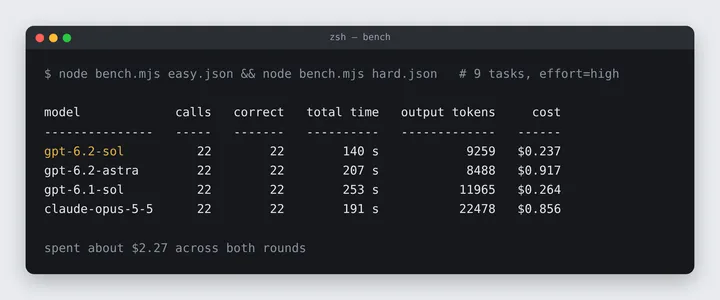
| Model | API ID | Price per 1M tokens (in / out) | Correct | Time, 22 calls | Output tokens | Cost, 22 calls |
|---|---|---|---|---|---|---|
| GPT-6.2 Sol | gpt-6.2-sol | 10 | 22 / 22 | 140 s | 9,259 | $0.24 |
| GPT-6.2 Astra | gpt-6.2-astra | 40 | 22 / 22 | 207 s | 8,488 | $0.92 |
| GPT-6.1 Sol | gpt-6.1-sol | 10 | 22 / 22 | 253 s | 11,965 | $0.26 |
| Claude Opus 5.5 | claude-opus-5-5 | 20 | 22 / 22 | 191 s | 22,478 | $0.86 |
Prices are the standard rates on OpenAI’s pricing page and Anthropic’s model list on November 18, 2026. The whole experiment, both rounds, cost $2.27.
How I Tested
What I Used
- A small Node.js script that sends one prompt to a model, times the call from request to finished answer, reads the token counts from the API response and grades the answer in code.
- OpenAI’s Responses API for the three GPT models and Anthropic’s Messages API for Opus 5.5, all at high reasoning effort (
reasoning.effort: "high"andoutput_config.effort: "high"). - One run on a GitHub Actions runner in the US, the evening of November 18 (Pacific), the day after the release.
The Nine Tasks
| Task | What the model had to do | How the script graded it |
|---|---|---|
| Duration parser | Write a JavaScript parseDuration("1h 5m 10s") | 14 hidden test cases in a vm sandbox |
| Calculator | Write evaluate(s) with powers, unary minus and error cases, no eval | 22 hidden test cases, including -2^2, 2^3^2 and () |
| Counting | Integers below 1000 divisible by 3 or 5 but not 15 | exactly 400 |
| Sales table | Highest Q2 revenue by region in a CSV where the top two are close | region and amount to the cent |
| Messy email | Name, invoice, amount, currency, due date as JSON; the amount is written in words and the PDF figure is wrong | 5 fields |
| Writing rules | 3 sentences, under 60 words, must say “waterproof”, three banned words | 4 rules |
| Logic puzzle | 5 people, 5 pets, 5 drinks, 13 clues, one unique answer (checked by brute force first) | exact answer |
| Business days | 45 business days after 2026-11-19, skipping weekends and 7 closed days | exact date |
| Long log | Count and sum matching rows in a 900-row shipping log (~23,000 tokens) | count and total weight |
The first five ran twice per model and the last four three times: 22 calls per model, 88 calls in all.
Round 1: Everyone Aced It
My first round was only the five easier tasks, and all four models went 10 for 10. That told me nothing about quality, so I wrote the harder four (the calculator, the puzzle, the date count and the long log) and ran them three times each.
Round 2: Still Nobody Missed
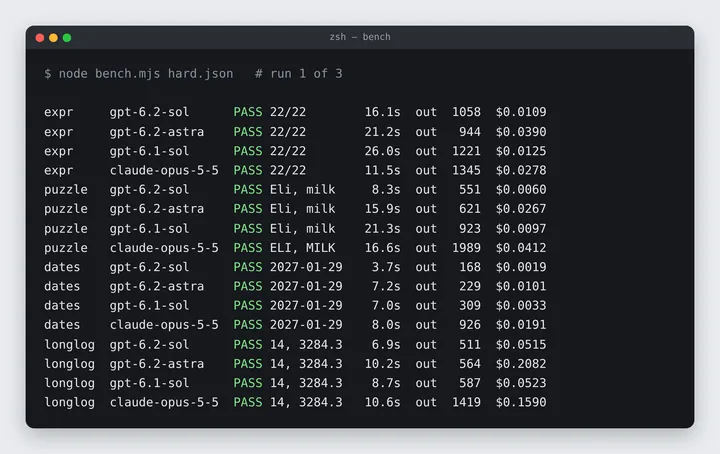
Same result: 12 of 12 for every model. The calculator, the one I expected to break something, passed all 22 hidden cases on every run. So the comparison comes down to speed, tokens and cost.
Results, Task by Task
Median seconds per call and average cost per call:
| Task | GPT-6.2 Sol | GPT-6.2 Astra | GPT-6.1 Sol | Claude Opus 5.5 |
|---|---|---|---|---|
| Duration parser | 7.1 s · $0.004 | 8.8 s · $0.014 | 14.7 s · $0.007 | 10.2 s · $0.020 |
| Calculator | 16.6 s · $0.013 | 18.6 s · $0.034 | 26.0 s · $0.013 | 14.0 s · $0.033 |
| Counting | 2.6 s · $0.001 | 3.1 s · $0.002 | 5.4 s · $0.002 | 3.1 s · $0.006 |
| Sales table | 1.9 s · $0.001 | 3.1 s · $0.005 | 2.2 s · $0.001 | 4.4 s · $0.011 |
| Messy email | 1.9 s · $0.001 | 2.7 s · $0.004 | 2.7 s · $0.001 | 2.1 s · $0.004 |
| Writing rules | 3.3 s · $0.001 | 12.3 s · $0.011 | 5.5 s · $0.002 | 5.9 s · $0.013 |
| Logic puzzle | 9.0 s · $0.007 | 17.1 s · $0.029 | 21.3 s · $0.009 | 16.6 s · $0.041 |
| Business days | 3.4 s · $0.002 | 5.6 s · $0.009 | 9.3 s · $0.004 | 7.7 s · $0.019 |
| Long log | 7.0 s · $0.052 | 10.2 s · $0.210 | 8.7 s · $0.054 | 10.2 s · $0.158 |
GPT-6.2 Sol vs Astra: Which Should You Use?
Astra is four times the price per token, and in my runs it was slower than Sol on all nine tasks while giving the same answers. On the 900-row log one Astra call cost about 0.05.
That does not make Astra pointless. My longest call took under 30 seconds; Astra is sold for long, hard work such as big refactors and multi-step agents, where one wrong turn costs more than the tokens. Simon Willison’s single-prompt drawing test points the same way for small jobs: 2.41¢ on Sol at high effort, 11.55¢ on Astra. My rule after this: Sol by default, Astra only when the task is long and a mistake is expensive.
GPT-6.2 Sol vs 6.1 Sol: Is the Upgrade Worth It?
Same price, same endpoints, and the new one is clearly better tuned. 6.2 Sol finished the set in 140 seconds against 253 and wrote about 23% fewer output tokens. The reasoning counts show why: on the logic puzzle, 6.1 Sol used 667 to 829 reasoning tokens per run, 6.2 Sol 334 to 379, for the same answer. If you have gpt-6.1-sol in a config somewhere, changing it to gpt-6.2-sol is the cheapest speed-up you’ll get this month.
GPT-6.2 Sol vs Opus 5.5
Both were perfect. Opus 5.5 was the fastest model on the calculator, the hardest coding task, but it wrote 2.4 times as many output tokens as Sol (its thinking is billed as output), so it cost about 3.6 times as much overall.
One detail worth knowing when you compare prices per token: the same 900-row log counted as 23,209 input tokens on OpenAI and 32,648 on Anthropic. The per-token price gap between two providers is not the per-task price gap.
GPT-6.2 Sol Pricing, Specs and Gotchas
From OpenAI’s model page and pricing page, November 18, 2026:
| Input | Cached input | Output | |
|---|---|---|---|
| Standard | $2.00 | $0.10 | $10.00 |
| Batch | $1.00 | $0.05 | $5.00 |
| Over 272K input tokens | $4.00 | $0.20 | $15.00 |
| Fast mode | $4.00 | $0.20 | $20.00 |
- Context window 1,050,000 tokens (up to 922,000 input), max output 128,000, knowledge cutoff June 1, 2026.
- Text and image in, text out. Chat Completions, Responses and Batch; no fine-tuning, Realtime or Assistants.
- The API rejects
reasoning.effort: "none". If you are migrating code that turned reasoning off for cheap calls, set a real level. - Astra is 40 standard, and its long-context rate is 60.
What I Didn’t Test
- Long agent runs. That’s Astra’s home turf; nothing here took longer than 30 seconds.
- Published benchmarks. OpenAI’s launch post didn’t load for my script, so I quote no benchmark scores.
- ChatGPT. This is the API only; which ChatGPT plans get which model is on OpenAI’s side.
What I’d Take Away from It
- For everyday API work, GPT-6.2 Sol is the default now. Right every time in my runs, fastest of the four, cheapest per task.
- Upgrade from 6.1 Sol today. Same bill, nearly half the wall time.
- Pay for Astra deliberately. It earns its price on long, risky work, not on extraction or tables.
- Measure per task, not per token. Output length and tokenizers moved the real cost more than the list price did.
FAQ
What is GPT-6.2 Sol?
GPT-6.2 Sol is an OpenAI language model released on November 17, 2026, alongside GPT-6.2 Astra. It is the cheaper, faster tier below Astra and replaces GPT-6.1 Sol at the same price. Its API ID is gpt-6.2-sol.
What is GPT-6.2 Sol pricing?
GPT-6.2 Sol costs 10 per million output tokens at standard rates, 0.24 in total.
6.2 Astra vs Sol: which should I use?
Sol for most work. Astra is four times the price per token; on my nine tasks it gave the same answers and was slower on every one. Use Astra for long, hard tasks where a mistake costs more than the tokens.
6.2 Sol vs 6.1 Sol: what changed?
In my test it was just as accurate and much faster at the same price: 140 seconds against 253 for the same 22 calls, with about half the reasoning tokens on the logic puzzle.
GPT-6.2 Sol vs Opus 5.5: which is better?
On my tasks both got everything right. Sol was faster on eight of nine tasks and about a quarter of the cost; Opus 5.5 was faster on the hardest coding task.