GeekCoding101
So, on launch day I read two claims about Claude Fable 5.2 that can’t both be right.
Anthropic: at High effort, Fable 5.2 scores about the same as Opus 5.5’s best score (45.3% vs. 45.5% on FrontierCode 2.0) “for roughly half the cost per task.”
An independent test (Atomic Agent) on one coding task: Fable 5.2 cost 1.9x Opus 5.5 at medium and 4.5x at high.
I had a brief lying around that’s harder than a coding kata and much smaller than “build an OS”, so I ran it on three models at three effort levels and read every number from the session transcripts.
TL;DR
- Fable 5.2 at medium was the surprise: the fastest run of all nine settings, same token use as Opus medium, and some ideas Opus only had at xhigh. It cost 1.8x Opus medium.
- At higher effort Fable 5.2 spends a lot more: 2.3x Opus at high, 2.4x at xhigh. Its xhigh used 1.6x the output tokens of Fable 5.1, so it cost more than 5.1 despite the 20% price cut.
- Both claims are “right.” They compare different things (cross-effort vs. same-effort) on tasks of different difficulty.
- Opus 5.5 checked its own work far more often.
- My biggest mistake: my first “Fable 5.2” round actually ran on Fable 5.1. Read the logs.
The test
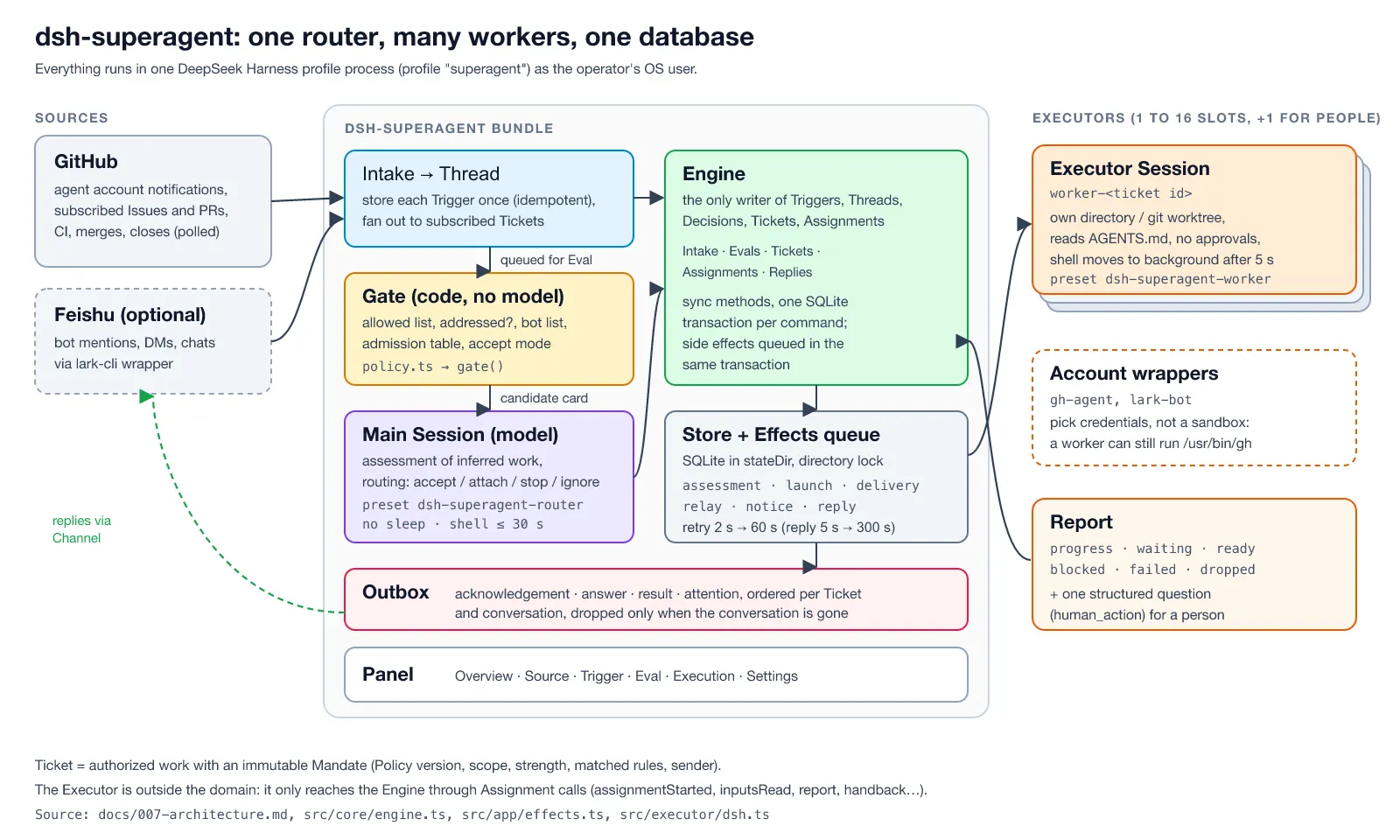
- Task: in Claude Code, Claude turns an open-source GitHub repo into a 60-second vertical explainer video. It reads the repo, writes a storyboard, writes a web page that draws each frame, records a voiceover, and stitches it all with FFmpeg.
- Repos: a CLI tool, a math formalization project, and a small game engine, each with a fixed visual style (retro terminal, chalkboard, pixel mini-game).
- Effort: medium, high, xhigh, set explicitly every time.
- Models: Opus 5.5, Fable 5.1, Fable 5.2.
- Control: the brief was identical across all runs. One rule in it matters later:

- Measurement: wall time, tokens and self-fix rounds come from the transcripts. Cost is the API-price equivalent (input, output, cache writes and reads at list price), not what the agent says.
The numbers
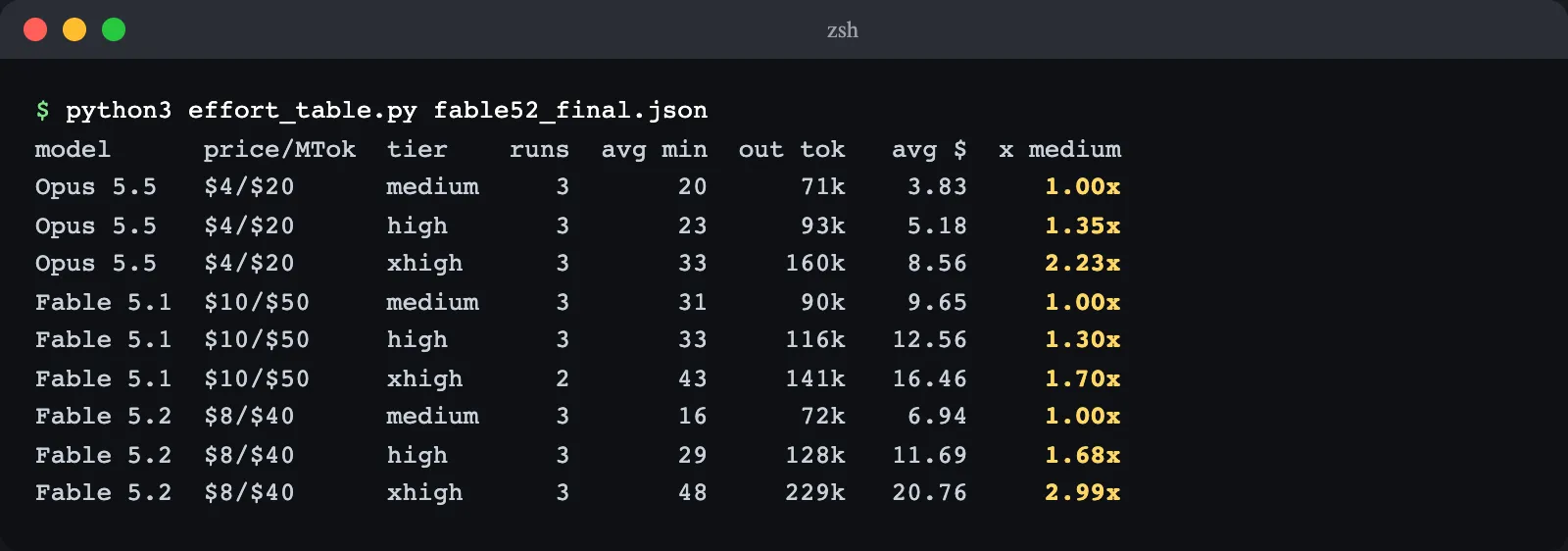
Average per video (3 runs per cell; cost / wall time / output tokens):
| Effort | Opus 5.5 ($4 / $20) | Fable 5.1 ($10 / $50) | Fable 5.2 ($8 / $40) |
|---|---|---|---|
| medium | $3.83 · 20 min · 71K | $9.65 · 31 min · 90K | $6.94 · 16 min · 72K |
| high | $5.18 · 23 min · 93K | $12.56 · 33 min · 116K | $11.69 · 29 min · 128K |
| xhigh | $8.56 · 33 min · 160K | $16.46 · 43 min · 141K* | $20.76 · 48 min · 229K |
*Only 2 runs; the third hit my monthly spend cap.
Three things stand out.
1. Fable 5.2 medium is fast and lean. 16 minutes per video, 4 minutes faster than Opus medium, with almost identical output tokens (72K vs. 71K). The 1.81x cost difference is purely the per-token price.
2. Effort scales Fable 5.2’s spending much more steeply. Versus Opus at the same level: 1.81x at medium, 2.26x at high, 2.43x at xhigh. Within Fable 5.2, high cost 1.68x medium and xhigh cost 2.99x. For Opus those ratios were 1.35x and 2.23x.
3. I can’t confirm “half the cost.” Anthropic compared Fable 5.2 High with Opus 5.5 Max. I didn’t run Opus at max. The closest pair I have, Fable 5.2 high vs. Opus xhigh, has Fable at 1.37x the cost.
What the extra money bought
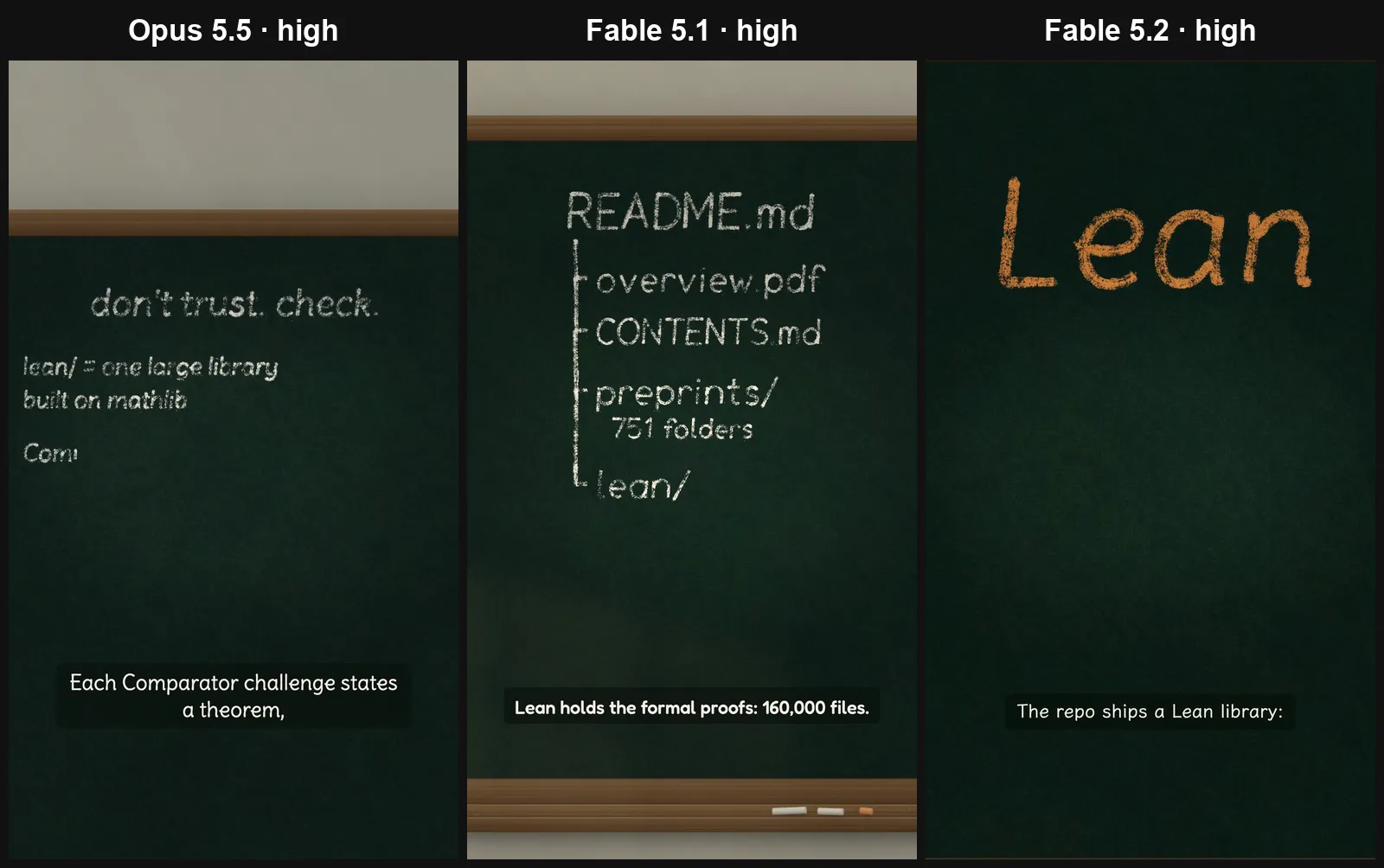
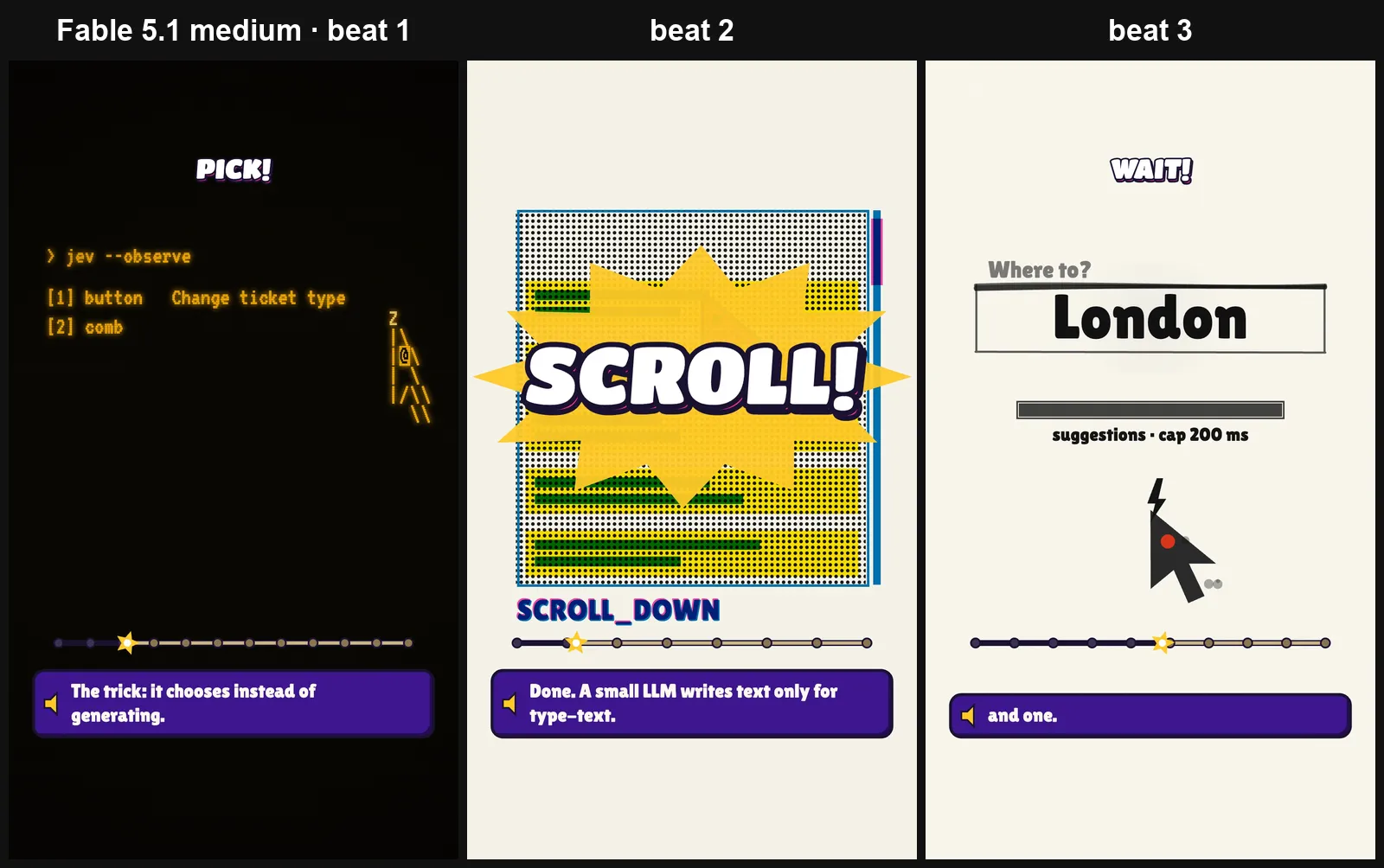
Fable 5.2 wins at medium. On the math repo it did a chalkboard “write it wrong, erase, rewrite in place” sequence at medium. Opus 5.5 and Fable 5.1 only did that kind of thing at xhigh.
Fable 5.1 also had ideas early. On the game engine, its medium run switched art style for every level, something Opus only did at xhigh.
Opus 5.5 wins on checking its own work. After rendering, did the agent run speech recognition on its own voiceover and compare it to the script?
| Model | Self-checked voiceover |
|---|---|
| Opus 5.5 | 4 of 9 (all 3 at xhigh) |
| Fable 5.1 | 0 of 8 |
| Fable 5.2 | 2 of 9 |
One Fable 5.1 run even noticed its TTS read port 3030 as “thirty-thirty”… and shipped it anyway.
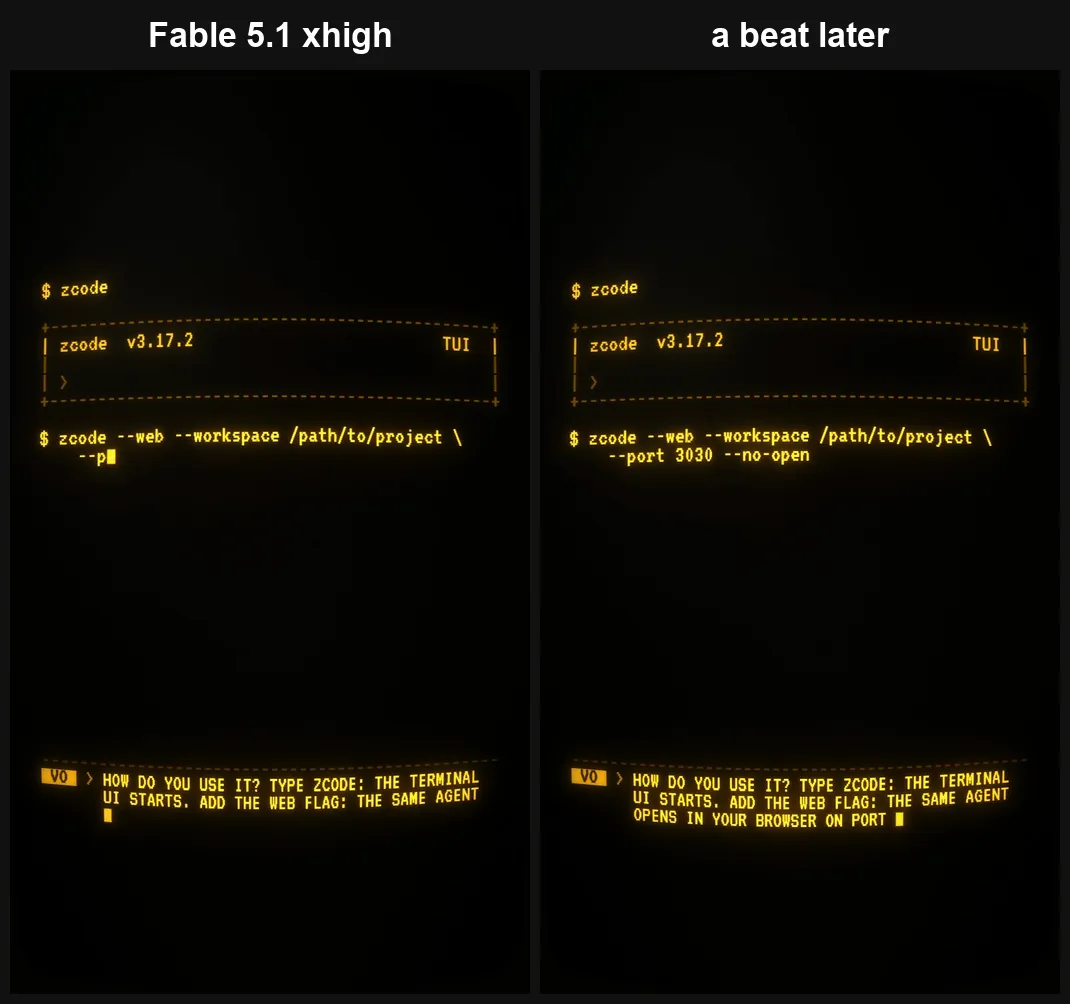
Fable 5.2 had a small slip too: one xhigh run planned a “silent beat” that muted the music but not the narration.
Why Anthropic and the independent test are both right
- Different comparisons. Anthropic: Fable High vs. Opus Max (cross-effort). Atomic Agent: same effort vs. same effort. My same-effort numbers agree with theirs in direction: Fable 5.2 costs 1.8–2.4x.
- Different difficulty. Their task was solved perfectly by Opus at medium, so the stronger model had nothing left to add except cost. On my task, Fable 5.2 medium produced things Opus needed xhigh for.
- Third-party data leans Anthropic’s way. Artificial Analysis has Fable 5.2 high at 62 points for about $9 per task, Opus 5.5 max at 59 for about $10.
So the real question isn’t “is Fable expensive?” It’s “does my task need what Fable adds, and is that worth ~1.8x?”
The mistake that cost me a whole round
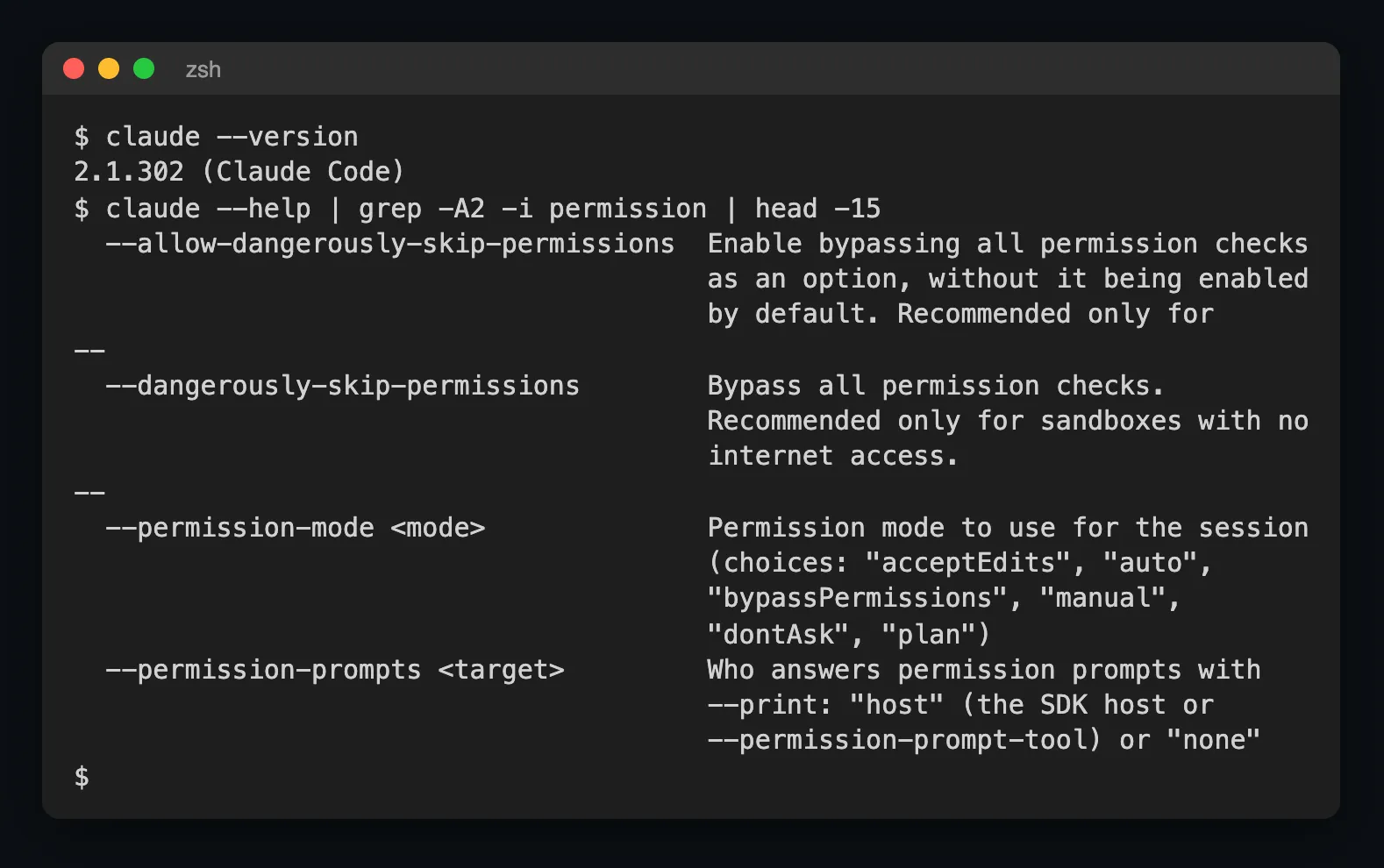
My first nine “Fable 5.2” runs finished. Then I grepped the transcripts:
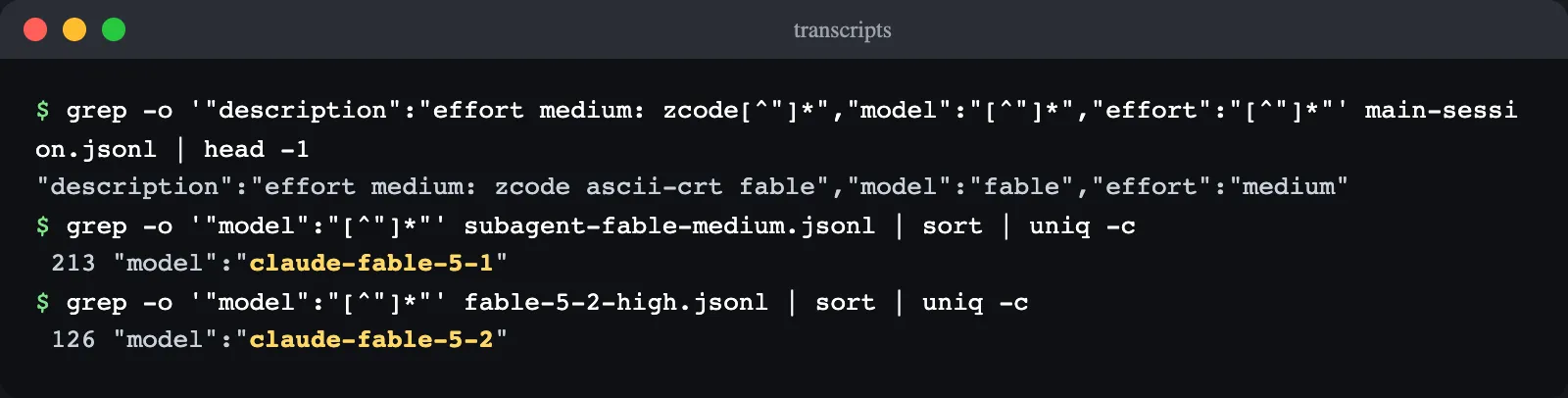
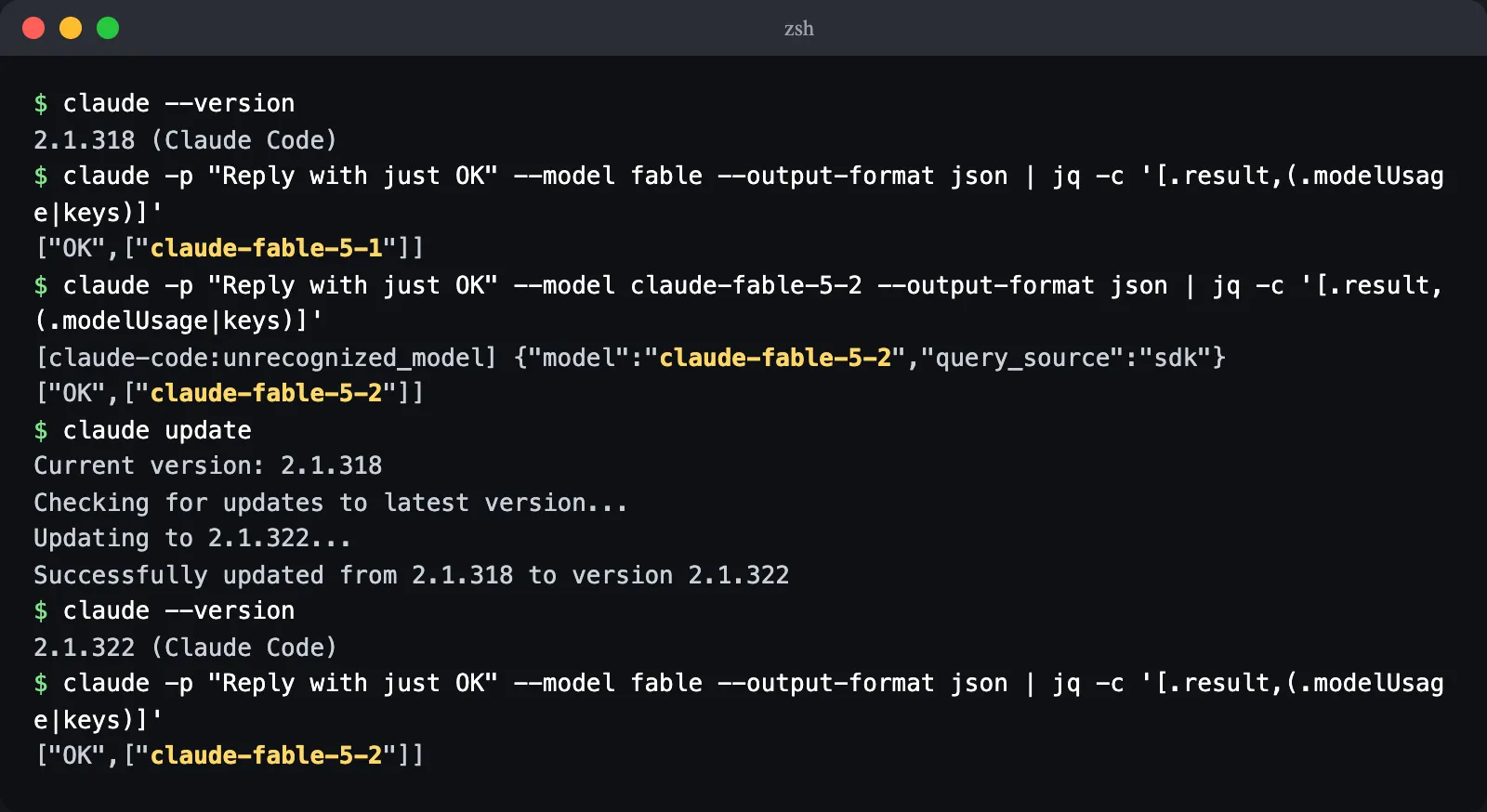
Every call was claude-fable-5-1. My subagents used the fable alias, and on the Claude Code version installed on that machine, fable still pointed to 5.1. Nothing in the UI said so, and the subagent can’t tell you either.
Same lesson as two earlier surprises:
- In an older test I asked 14 subagents to report their effort level. All said “low” or just “40.” The transcripts said high and xhigh.
- On Hacker News, someone told Fable 5.2 to use “max 4 subagents” on an 80k-line codebase review. It spawned 6+ nested subagents and burned a 5-hour allowance in under 20 minutes.
And the .env rule held for both Fable rounds: none of the 17 Fable runs read .env or .env.example. (That rule exists because an earlier Opus xhigh run decided a template “isn’t a secret.”)
How to set effort (and the model) correctly
Claude Code
Update Claude Code first, then check:
claude --versionclaude --model fable --effort mediumInside a session:
/model fable/effort mediumOther options (model config docs):
CLAUDE_CODE_EFFORT_LEVEL=medium(environment variable, overrides everything)effortLevelin settings, or per model inmodelSettings(low to xhigh, not max)/effort autoclears your saved level for the active model
For subagents (docs):
---name: repo-explainerdescription: Turns a repository into a 60-second explainer videomodel: fableeffort: medium---Then open a transcript and confirm the model field says claude-fable-5-2.
API
Thinking is always on for Fable 5.2. Effort is the control:
import anthropic
client = anthropic.Anthropic()
with client.messages.stream(    model="claude-fable-5-2",    max_tokens=64000,    output_config={"effort": "medium"},    messages=[{"role": "user", "content": "Explain this repo's architecture: ..."}],) as stream:    message = stream.get_final_message()
if message.stop_reason == "refusal":    print("Blocked by a safety classifier:", message.stop_details)else:    print(message.content[-1].text)
Gotchas:
thinking: {type: "disabled"}orbudget_tokensreturns a 400. Lower effort instead.- At high and above, set a large
max_tokensand stream; thinking counts toward it. - Effort barely changes reply length. Ask for length in the prompt.
- Lower levels stop early more often on long agentic tasks; Anthropic suggests a “finish the whole task” section in the system prompt.
What I’m doing now
- Default for batch work: Opus 5.5 at high. Cheap, and it checks its own output.
- When I want more creative output without waiting longer: Fable 5.2 at medium. Fastest run in the test, ~1.8x the cost.
- Fable 5.2 high / xhigh: only for work Opus at xhigh can’t do. For 60-second explainers, not worth 2.3–2.4x.
- max: basically never.
That lines up with Anthropic’s own advice: start with Opus 5.5 as the daily driver, step up to Fable for the hard stuff, or use Fable 5.2 as an Advisor (smaller models consult it) or Orchestrator (it delegates simpler work).
Launch facts, quickly
| Item | Fable 5.2 |
|---|---|
| Price | $8 / $40 per million tokens (Fable 5.1: $10 / $50) |
| Fast mode | $16 / $80, up to 2.5x faster |
| Speed vs 5.1 | up to 30% faster output |
| Effort levels | low, medium, high, xhigh, max |
| Model ID | claude-fable-5-2 (Claude API, AWS, Google Cloud, Azure) |
From the announcement and system card: Anthropic deliberately limited the capabilities that most directly speed up AI R&D (accelerator kernel optimization, LLM architecture work) to about Opus 5.5’s level. Requests blocked by safety classifiers are answered by an older model (Opus 4.8 for cyber, Opus 5 for bio), and false blocks are down about 55% vs. 5.1.
Takeaways
- Same effort level: Fable 5.2 cost 1.8–2.4x Opus 5.5 on my task.
- Fable 5.2 at medium was the fastest setting and had ideas Opus needed xhigh for.
- Fable 5.2 spends much more as effort rises; its xhigh cost more than Fable 5.1’s.
- “Half the cost” compares Fable High with Opus Max, so check which comparison you’re actually making.
- After a model launch, update Claude Code and verify the model in the transcript.